

(4 Minutes Read)
The U.S. hosted a surprise mini-summit with five strategically located but economically smaller African nations, signaling a shift from aid-based diplomacy to a transactional, resource- and security-driven approach. This move reflects Washington’s intent to counter growing Chinese and Russian influence in West and Central Africa, secure critical minerals for clean energy, and address security threats and illegal migration. However, the exclusion of Africa’s major economies, lack of clarity on AGOA’s future, and visa restrictions raise questions about the long-term viability and sincerity of this new U.S.–Africa engagement strategy.
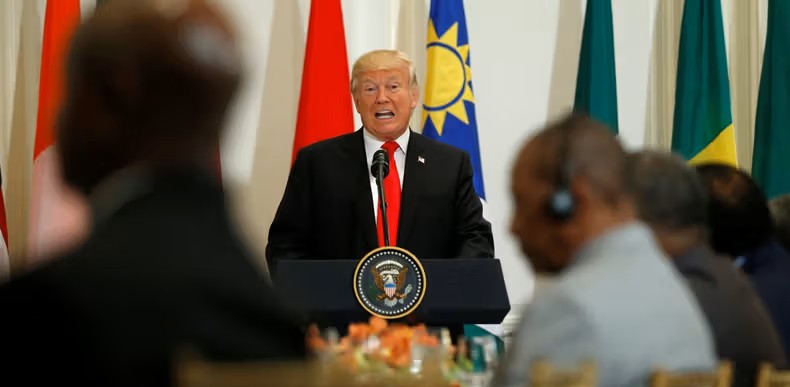
In a major diplomatic outreach to Africa, Washington hosted heads of five African nations—Gabon, Guinea-Bissau, Liberia, Mauritania, and Senegal from July 9-11. The sudden announcement about the Summit, just after the 17th Corporate Council on Africa’s Business Summit in Angola from June 22 to 25, 2025, came as a surprise. It also marked a major policy shift in both approach and country selection.
The Angolan Conference struck a positive note with $2.5 billion worth of U.S.–Africa business commitments, focusing on energy, infrastructure, and trade. Yet, African leaders were deeply concerned about the drastic cut in US development aid, ambiguity on climate policy, and migration. Therefore, this invitation by Trump raised expectations of the African leaders.
What intrigued political observers about this mini-summit was the invitee list. For instance, Guinea-Bissau has no U.S. embassy and hardly any trade with the U.S. All five invitee nations are small economies by GDP. Then what is lucrative about these countries? The mineral wealth and strategic importance. These factors seem to have taken precedence over their market size and political and economic stability.
The US is sending a clear signal: it is determined to move away from its traditional aid-based Africa strategy to a transactional model, defined by remunerative deals rather than soft power and goodwill. The US Development Finance Corporation’s announcement of funding support for Gabon’s Banio Potash Mine exemplifies this strategy.
All five invited countries hold rich reserves of manganese, cobalt, uranium, oil and gas. Gabon holds 25% of global manganese reserves. These minerals are key to global supply chains, particularly in the clean energy transition.
The strategic position of these five countries with Atlantic Ocean access also adds a security angle. The US is deeply concerned about piracy, illegal migration routes, and the growing Chinese and Russian presence in the resource-rich but geopolitically volatile West and Central African region. Reports of China scouting for port sites in Gabon, Mauritania, and Guinea have put the US on alert. Capitalizing on the US concerns, Gabon President Brice Oligui Nguema highlighted Gabon’s strategic location along the Gulf of Guinea for a US military base.
Security threats in the Sahel region, a global terrorism hotspot, are of growing concern to U.S. counterterrorism interests. The region’s ruling juntas in Mali, Burkina Faso, and Niger are increasingly aligning with Russia, while U.S. forces face expulsion. Experts suggest that through this summit, the U.S. aims to reassert its influence and prevent the spread of terrorism into coastal West Africa.
The U.S. has recently brokered a peace deal between the Democratic Republic of Congo and Rwanda, ending years of hostilities. Political observers view this peacebuilding strategy by the U.S. as a tool to unlock economic opportunities, especially in the mining sector.
Some experts also interpret this move by the U.S. President as an attempt to counter the perception of America’s indifference to Africa while China and Russia expand their footprints in Africa. However, Trump’s selective engagement strategy, side-stepping the major powers like Nigeria, Egypt, Ethiopia, and South Africa, belies this view. All of them are BRICS members or aspiring members, while none of these five invited African nations fall into the BRICS category. Given his hostility to BRICS, the exclusion of the major African economies from the summit is understandable.
Surprisingly, four of the five countries are reportedly on the list of countries with travel bans to the US. This adds a diplomatic twist to the meeting. Illegal Migration was one of the top priorities in the discussion. Senegal and Mauritania serve as major gateways for illegal migrants to the US. There are reports that Liberia may be approached to host deportees from the US. Given the challenges of governance, health, and institutional challenges in these countries, critics are sceptical about commercial prospects. How trade can thrive under tariffs and visa bans is another question.
The mini summit is considered a precursor to a larger Summit in September, coinciding with the U.N. General Assembly. Importantly, in September this year, AGOA will expire. Trump was tight-lipped about the future of AGOA, avoiding a direct response to that, intensifying speculation around its rollover.
Perhaps, the main summit will unfold a clear strategy on how the US will balance its transactional approach with business partnerships. Hopefully, it will chart a new course to U.S. engagement in Africa, heralding a mutually beneficial economic partnership. As more global powers turn their attention to Africa as a business destination, we can only hope that the continent will secure better deals that truly improve the lives of its people.