


(3 Minutes Read)
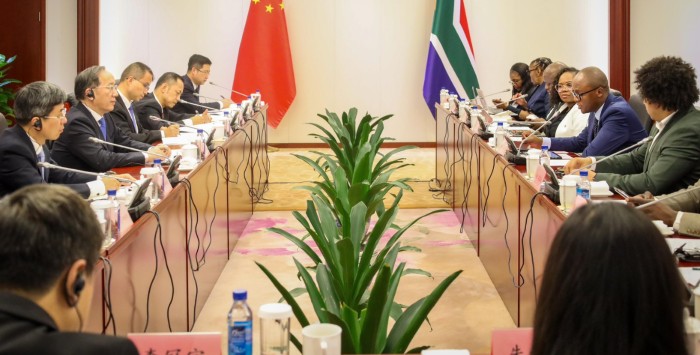
Following a recent official trip to China, South Africa’s Minister of Communications and Digital Technologies, Solly Malatsi, revealed that his delegation held key engagements with Chinese tech stakeholders to explore satellite broadband solutions that could bolster South Africa’s digital infrastructure—particularly in underserved and rural areas.
Malatsi, accompanied by senior officials from his department, visited China with a specific agenda: to strengthen bilateral cooperation on digital technologies and identify scalable solutions to close South Africa’s digital divide. A central part of this mission involved engaging with China Satellite Network Company (CSNC)—a state-owned enterprise established in 2021 to build and operate a large-scale satellite internet network.
The CSNC aims to launch a constellation of 13,000 low-Earth orbit (LEO) satellites, a system comparable to SpaceX’s Starlink. These LEO satellites, which operate at altitudes between 500 and 1,145 km, are capable of delivering low-latency, high-bandwidth internet—a significant improvement over traditional geostationary satellites positioned over 30,000 km from Earth.
Malatsi confirmed that discussions with CSNC centered on leveraging this technology to address the “last-mile connectivity” problem in South Africa—ensuring that even the most remote communities gain access to reliable, affordable internet services. This aligns with our national priority to close the digital divide and ensure equitable access to essential services, the minister stated.
Despite 99% of South Africa being covered by LTE mobile networks, mobile data remains prohibitively expensive for many, especially in rural and impoverished communities. Moreover, fixed-line Internet access is available to only 14.5% of the population, according to a recent report by the Independent Communications Authority of South Africa (Icasa).
In contrast, LEO satellite internet has emerged as a disruptive alternative across the continent. Starlink, the dominant player in this space, has already launched over 7,000 satellites and serves over 5.3 million users globally. Starlink’s rapid expansion across Africa underscores its potential: by the end of 2024, it was active in 18 African nations, including Nigeria, Kenya, and Mozambique.
South Africa, however, has not yet authorized Starlink operations due to local telecommunications licensing regulations, which include specific ownership requirements. This has delayed its entry into the country, even though pre-orders opened as early as February 2021.
Besides satellite connectivity, Malatsi also pursued technology partnerships during his China visit. Meetings with major firms like Huawei and Honor focused on expanding access to affordable smart devices—particularly for learners and small business owners—as part of South Africa’s broader digital inclusion strategy.
The minister also took part in international tech forums, including the 2025 World Artificial Intelligence Conference and the High-Level Meeting on Global AI Governance held in Shanghai. These events provided a platform for discussing not only emerging tech trends but also global policy frameworks to guide AI development.
The need for affordable and accessible internet is not unique to South Africa. Across Africa, countries have turned to satellite internet as a practical solution for their digital challenges. For example:
- In South Sudan, only 12.1% of the population had internet access as of January 2024.
- In Somalia, currently facing conflict and instability, Starlink was recently licensed to operate, demonstrating the resilience and reach of LEO satellite connectivity.
As of mid-2025, Starlink has launched services in three more African countries—Niger, Liberia, and Lesotho—and is expected to expand into an additional 18 countries by year-end.
Read Also:
Minister Malatsi’s visits signal a clear intent by the South African government to explore alternative connectivity models through international collaboration. With traditional infrastructure slow to reach remote areas, satellite broadband may offer the fastest route to digital inclusion, provided regulatory and economic frameworks align.
By partnering with Chinese satellite firms and global tech giants, South Africa is seeking not only to modernize its digital landscape but also to ensure that no citizen is left behind in the digital age.