

(3 Minutes Read)
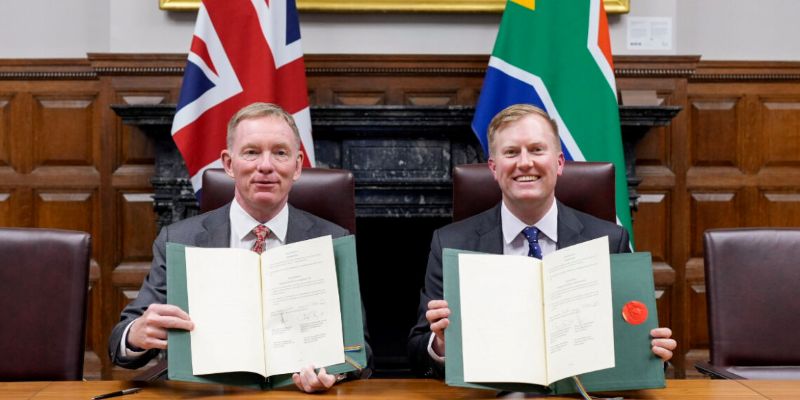
South Africa and the United Kingdom have signed a significant Memorandum of Understanding (MoU) to advance infrastructure development and improve public asset management throughout South Africa. Formalised in London, the agreement will see the UK provide technical expertise and capacity-building support valued at nearly R10 million, reinforcing South Africa’s ongoing infrastructure reform efforts.
The MoU was signed by South Africa’s Minister of Public Works and Infrastructure, Dean Macpherson, and UK Minister of State for Business and Trade, Chris Bryant. This collaboration follows earlier engagements between Macpherson and UK Chancellor of the Exchequer, Rachel Reeves, during a visit to Durban, where both parties reaffirmed their commitment to sustainable infrastructure and institutional reform.
According to the Department of Public Works and Infrastructure (DPWI), the partnership will focus on three strategic programmes:
- Project Capstone – Aimed at strengthening the Special and Strategic Delivery Unit (SSDU) within the DPWI, which is tasked with resolving systemic challenges that delay infrastructure implementation.
- Project Speed – Focused on improving the management and utilisation of government-owned properties, ensuring assets are maintained and deployed strategically.
- Adopt-a-Municipality Programme – Led by Infrastructure South Africa, this initiative will provide targeted technical support to selected municipalities, enhancing local infrastructure delivery capacity.
Minister Macpherson described the MoU as a tangible step toward positioning South Africa as a “construction hub,” using public assets to drive economic growth and job creation. He emphasised the partnership’s alignment with broader public sector reforms centred on transparency, efficiency, and sustainability.
“This agreement lays the groundwork for stronger project preparation, improved infrastructure delivery, and skills development within the public sector,” said Macpherson. “It’s more than just financial or technical support — it’s about building long-term institutional strength to deliver projects on time and within budget.”
Observers view the collaboration as part of a broader trend across Africa, where countries are leveraging international expertise while maintaining control over their development priorities. Unlike past models that often-imposed external solutions, this approach places African institutions at the heart of planning and implementation.
The UK’s involvement reflects its commitment to infrastructure resilience and green growth across Africa, in line with its “Global Britain” agenda. However, both nations have stressed that this partnership is mutually beneficial — not a donor-driven initiative — and is designed to attract private investment and stimulate long-term economic growth.
As infrastructure continues to be a vital lever for transformation across the continent, this South Africa–UK MoU symbolises a shift toward equitable, knowledge-based cooperation that respects national sovereignty and prioritises sustainable development. It also reinforces the African Union’s Agenda 2063 by promoting decentralisation, local empowerment, and capacity-building at the municipal level.
Read Also;
For South Africa, the agreement complements broader efforts to transform the Department of Public Works and Infrastructure into a key catalyst for inclusive growth. By unlocking the potential of underutilised public assets, the department aims to generate employment, revitalise communities, and create resilient infrastructure systems tailored to local needs. This collaboration is expected to serve as a blueprint for future Global South–North partnerships that are founded on mutual respect, transparency, and shared learning — proving that the most effective development models are those rooted in local ownership and long-term impact.