


By. Dr. Tony Augustine*
(3 Minutes Read)
What happens to electric vehicle (EV) batteries once they can no longer power a car? This question is increasingly important for two main reasons. First, the battery is the most expensive component of an EV, accounting for up to 40% of its total cost. Second, these batteries contain valuable and potentially hazardous materials—such as lithium, cobalt, and nickel—that require careful handling and responsible disposal.
Despite occasional hurdles, the electric vehicle (EV) revolution is picking up speed globally. In 2023, global EV sales surged by 35%, reaching around 14 million units. By 2024, they grew another 20%, crossing 17.1 million units. African countries, though at a nascent stage, are gradually beginning to mirror this trend. Countries like South Africa, Kenya, Rwanda, and Ghana are seeing a rise in EV adoption, supported by policy incentives and a growing awareness of the need for sustainable mobility solutions.
However, this growth brings new challenges to the forefront—particularly around what happens to EV batteries when they reach the end of their useful life in vehicles. This issue is vital for two key reasons. Firstly, batteries make up nearly 40% of the cost of an EV. Secondly, they contain critical materials—like lithium, cobalt, and nickel—that are not only expensive but also hazardous if not disposed of properly. Without proper systems for battery recycling or reuse, Africa risks facing a wave of toxic waste, with serious health and environmental consequences.
Globally, governments are tightening regulations to ensure safe and responsible battery disposal. But forward-thinking companies are starting to look at this challenge as a unique opportunity. They propose an innovative solution: instead of recycling used EV batteries right away, we should repurpose them for a second life. This strategy doesn’t just protect the environment; it also creates economic value—a true win-win.
Beyond the First Life: A New Lease on Power
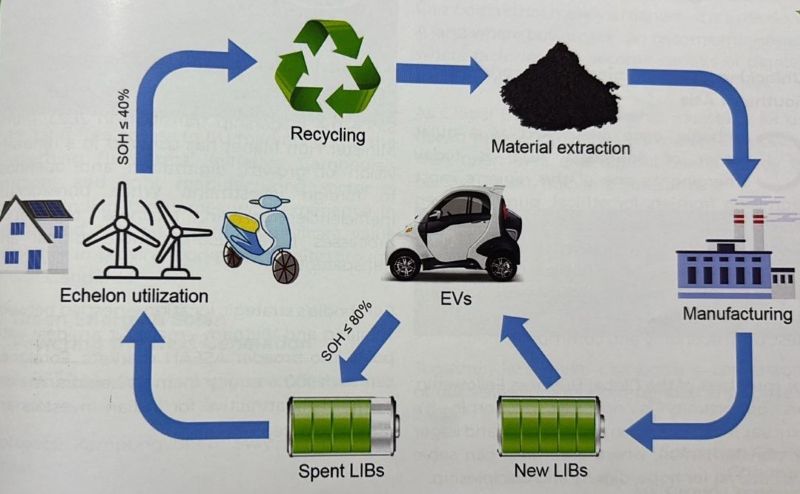
The lithium-ion battery is the heart of an EV and represents nearly 40% of its total cost. Typically, an EV battery is considered to have reached its end-of-life (EoL) when its performance drops to around 80% of its original capacity—known as State of Health (SoH). While it may no longer be reliable for powering vehicles, such a battery still holds significant energy potential. Discarding it at this point is not only wasteful but also economically short-sighted.
In African contexts—where every resource counts—we rarely discard valuable assets while they still retain 80% of their capacity. So why do it with EV batteries? These batteries can be repurposed for a variety of stationary, non-automotive applications, particularly in energy storage. Sending them for recycling prematurely leads to unnecessary waste and missed opportunities. By repurposing them, we not only extend their useful life but also make better use of the expensive raw materials already invested in their production.
Repurposed Batteries: Powering Africa’s Energy Future
Before they can be reused, these second-life batteries need to undergo strict testing and validation. Once approved, they can be redeployed in Energy Storage Systems (ESS)—a game-changer for Africa. Across the continent, millions live without reliable access to electricity. Even in urban areas, power outages are frequent, and many households and businesses rely on expensive diesel generators.
With abundant sunlight in countries like Nigeria, Kenya, Namibia, Botswana, and large parts of West and East Africa, solar power holds huge potential. But the lack of storage capacity has limited its effectiveness. Solar energy is only useful when the sun shines—without battery storage, much of it goes to waste. That’s where repurposed EV batteries come in.
They can provide reliable storage for solar power, enabling households and small businesses to go off-grid. This empowers people to be energy self-sufficient and reduces dependence on erratic national grids or costly fossil fuels. Across Africa, more and more people are installing solar panels. But without affordable battery storage, the returns on these investments remain low. Second-life EV batteries can bridge that gap.
A Second Life That Powers Development
Repurposed EV batteries can serve for another 5 to 8 years in their second life—making them an excellent solution for decentralised energy needs in Africa. They can support mini-grids, power remote schools and clinics, provide backup for urban homes, and reduce the need for diesel-powered alternatives.
Moreover, they can help bring down the overall cost of EV ownership. The limited resale value of EVs is one of the reasons many African consumers hesitate to adopt them. If the battery retains value even after its automotive life—because it can be resold or reused—that changes the economics of EV adoption.
But unlocking this potential will require robust policies, technical capabilities, and proper battery data management systems. Governments, industry stakeholders, and development partners must work together to build an ecosystem that supports battery repurposing. With the right investments, Africa can leapfrog into a greener, more energy-secure future—using innovation to turn today’s challenges into tomorrow’s opportunities.
In Summary
- EV adoption is growing slowly in Africa, but battery waste will become a real issue soon.
- Batteries retired at 80% SoH still hold valuable energy potential and shouldn’t be wasted.
- Repurposing EV batteries for solar energy storage can address Africa’s energy reliability and access gaps.
- This approach supports sustainability, energy independence, and economic growth.
- Robust policies and battery lifecycle data are key to unlocking this opportunity.
________________________________________________________
Dr. Tony Augustine is professional with over 25 years of experience in automobile and banking sectors. He has worked with leading companies like Tata Motors, HDFC bank and Toyota. He is an engineer by training and has doctoral degree in Electric Vehicles. He is currently part of a start-up which repurposes EV batteries for ESS applications.