

(3 Minutes Read)
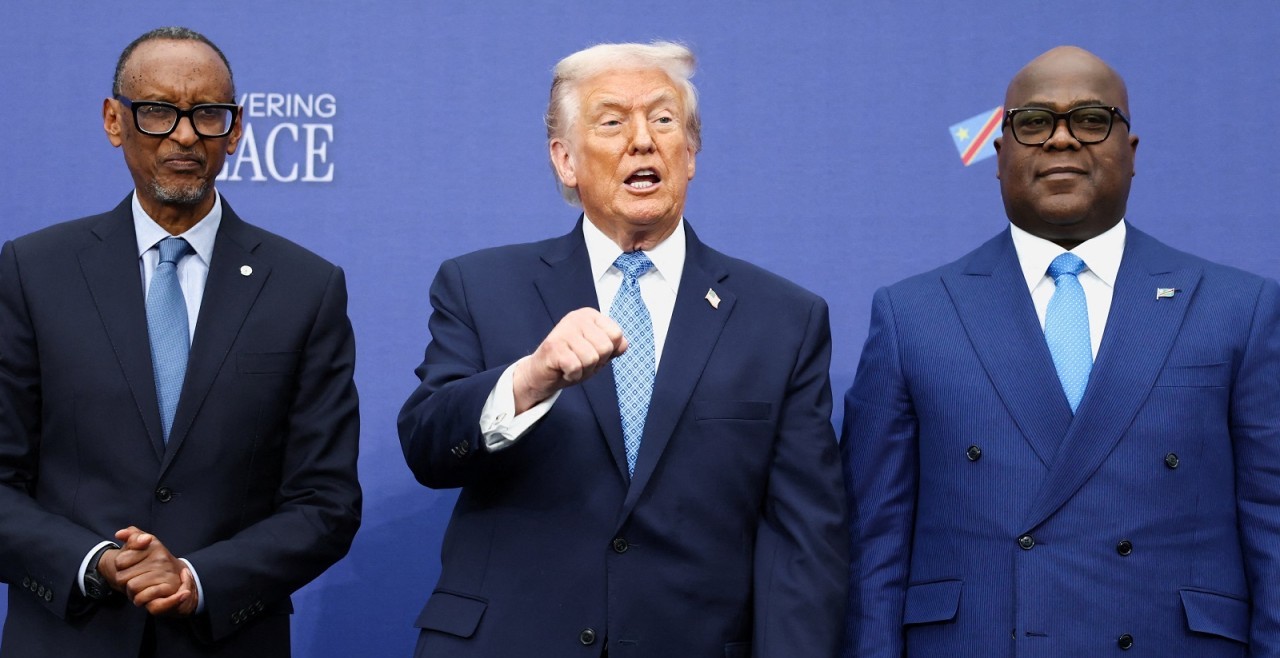
US President Donald Trump on Thursday hosted Rwandan President Paul Kagame and Congolese President Félix Tshisekedi in Washington for the signing of a new peace agreement, even as renewed fighting in eastern Democratic Republic of Congo (DRC) cast immediate doubt on the deal’s durability. Trump hailed the accord as a “great miracle” and announced parallel agreements granting the United States access to critical minerals in both countries—part of his broader effort to secure rare earth resources for American companies.
The ceremony took place at a peace institute recently renamed in Trump’s honour. The US president, who has repeatedly expressed his desire to win a Nobel Peace Prize, portrayed the moment as the end of one of Africa’s longest-running wars. “They spent a lot of time killing each other,” he said of Kagame and Tshisekedi, “and now they’re going to spend a lot of time hugging, holding hands, and taking advantage of the United States economically, like every other country does.”
But both African leaders struck more cautious tones. Kagame, whose alleged support for the M23 rebel movement has fueled regional tension, warned that the road ahead would bring “ups and downs.” Tshisekedi called the agreement merely “the beginning of a new path, a demanding path,” acknowledging the complexities of a conflict that has killed hundreds of thousands over decades.
Their reservations reflect the stark gap between the diplomatic optimism in Washington and the volatile situation on the ground. In eastern DRC, where the M23 rebel group—believed by the UN and Kinshasa to be backed by Rwanda—has recently made major territorial gains, clashes continued even as the leaders met. Heavy bombardments were reported around Kaziba and the M23-controlled town of Kamanyola, with local officials citing numerous casualties. Explosions were also heard near the Bugarama border crossing between Rwanda and Burundi, prompting a temporary border closure.
This instability mirrors escalating accusations from both sides. Earlier in the week, Kinshasa and M23 traded claims of ceasefire violations, threatening to derail the peace initiative before its formal unveiling. Rwandan Foreign Minister Olivier Nduhungirehe, speaking in Washington, argued that despite sporadic clashes, “meaningful progress” had been made and insisted that peace must be viewed as a gradual process. He defended Rwanda’s military presence in the DRC as a defensive measure until Kinshasa neutralizes the FDLR, a militia rooted in the remnants of the 1994 Rwandan genocide’s perpetrators.
DRC government spokesman Patrick Muyaya countered that Rwanda’s continued support for M23 undermines any genuine pursuit of peace. He emphasized that Congo is preparing operations to disarm the FDLR, while accusing M23 of provoking the most recent fighting as part of Kigali’s strategy to destabilize the region.
The Washington accord builds on earlier Trump-brokered initiatives, including economic integration plans aimed at attracting substantial Western investment into a region rich in tantalum, gold, cobalt, copper, lithium, and other vital minerals. Trump has openly linked the peace process to mineral extraction opportunities, telling US firms are poised to benefit significantly: “We’re going to take out some of the rare earth, and everybody’s going to make a lot of money.”
Read Also;
https://trendsnafrica.com/fight-breaks-between-m23-and-drc-forces-in-south-kivu/
Whether the new agreement can overcome entrenched mistrust and decades of conflict remains uncertain. Despite the diplomatic fanfare, the realities in eastern Congo—ongoing armed clashes, contested ceasefires, and deep strategic suspicion—suggest a long, uncertain road before any lasting peace can take hold.