


(3 Minutes Read)
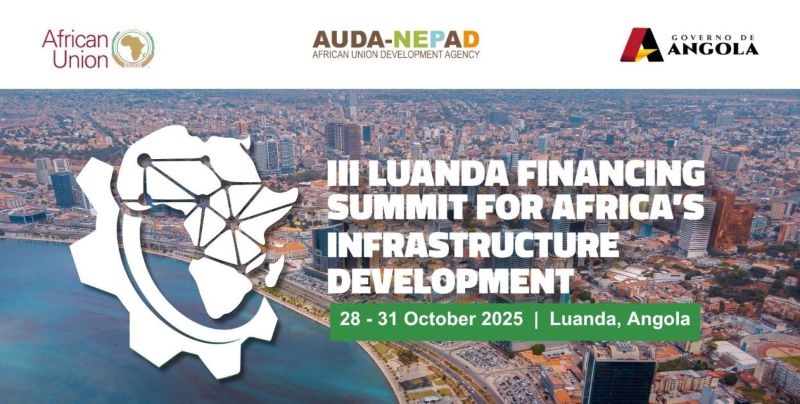
October 28 to 31, the Angolan capital, Luanda, will host the Third Summit on Financing for Infrastructure Development in Africa, an event expected to attract over 2,000 delegates, including heads of state, ministers, investors, and representatives of financial institutions. Organized with the technical support of the African Union Development Agency (AUDA-NEPAD), the summit coincides with Angola’s 50th anniversary of independence and seeks to mobilize up to USD 160 billion to bridge Africa’s infrastructure financing gap.
According to Mário Rui Pires, former Secretary of State for Public Investment of Angola and current consultant in economic development, the summit provides a unique opportunity for African nations to submit funding proposals for infrastructure projects that align with sustainable financing models.
Pires highlighted that financial institutions increasingly favor self-sustaining projects, meaning those capable of generating sufficient revenue to repay loans within agreed terms and interest rates. This, he emphasized, remains one of the most critical challenges in Africa — and particularly in Angola, where project design and preparation often fall short of demonstrating financial viability.
As an example, Pires cited the proposed highway linking northern Soyo and southern Cunene, describing it as economically unviable given the country’s limited traffic flow. “Currently, our national road network suffers from poor quality due to lack of maintenance and from roads cutting through urban centers,” he noted. “A more effective approach would be building ring roads to divert traffic away from cities, reducing congestion and travel times. For now, a major highway is not economically sustainable.”
Pires stressed the importance of sound project preparation and economic modeling to attract investors and reduce reliance on sovereign guarantees, especially as Angola’s fiscal space is constrained by high debt levels. “Projects must be designed with clear economic logic to assure financiers that they can pay for themselves,” he maintained.
According to Arlindo Rangel, Chairman of the Angolan Private Investment and Export Promotion Agency (AIPEX), the summit’s target of USD 160 billion represents a concerted effort to address Africa’s infrastructure deficit and catalyze growth in key sectors such as transport, energy, telecommunications, agriculture, health, and education. While acknowledging that the USD 160 billion goal is ambitious, Pires placed it in perspective:
“Africa’s infrastructure investment needs are estimated at around USD 3 trillion by 2050. So this figure represents just about 5% of what’s needed, but it’s still substantial — provided countries come prepared with robust, bankable projects.” He further predicted that countries with stronger institutional capacity and project experience — including Nigeria, Ghana, Senegal, Côte d’Ivoire, Kenya, Ethiopia, South Africa, Egypt, Tunisia, and Morocco — are likely to secure a significant share of the funding.
Read Also;
As part of Angola’s rotating presidency of the African Union, assumed by President João Lourenço on February 15, 2025, infrastructure development has been positioned as a top continental priority. The overarching goal of the Luanda Summit is to mobilize international resources for transformative projects that promote sustainable development, regional integration, and long-term economic resilience across Africa.