

(3 Minutes Read)
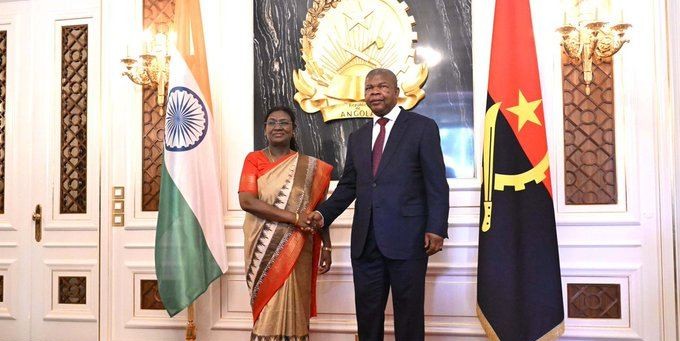
Indian President Droupadi Murmu’s historic state visit to Angola has marked a new chapter in India–Africa relations, signalling a deepening of strategic, economic, and technological engagement between New Delhi and Luanda. The visit — the first-ever by an Indian head of state to the Southern African nation — underscores India’s commitment to building long-term partnerships centred on energy security, critical minerals, and sustainable technology collaboration.
During her bilateral discussions in Luanda with President João Manuel Gonçalves Lourenço, President Murmu reaffirmed Angola’s pivotal role in India’s energy strategy. As one of Africa’s top oil producers, Angola has long been a reliable supplier of crude to India, which ranks among the world’s largest energy consumers.
“Angola plays a vital role in India’s energy security,” President Murmu stated, emphasizing that Indian companies are exploring long-term purchase agreements for oil and gas, as well as investments in exploration, production, and refinery infrastructure.
India, leveraging its advanced refining capacity and technological expertise, seeks to collaborate with Angola not merely as a buyer but as a co-developer of energy infrastructure. This aligns with India’s broader goal of fostering sustainable, mutually beneficial energy partnerships that promote local value addition, skills development, and industrial capacity within partner nations — a marked departure from traditional extractive models of engagement in Africa.
Beyond the energy sector, the two nations have identified strategic minerals and critical raw materials as a key area of cooperation. Angola, rich in mineral resources including rare earth elements, is seeking to diversify its economy beyond oil dependency. These minerals are crucial for electric vehicle batteries, semiconductor manufacturing, and AI technologies — all central to India’s transition toward a green and digital economy.
By fostering joint ventures and technology-sharing arrangements, both countries aim to advance industrial diversification, enhance technological self-reliance, and strengthen supply chain resilience within the Global South.
President Murmu’s visit also commemorates the 40th anniversary of diplomatic ties between India and Angola — a partnership built on mutual respect, shared developmental aspirations, and South-South solidarity. Earlier this year, India extended a USD 200 million Line of Credit to support the modernisation of Angola’s defence forces, reflecting New Delhi’s long-term strategic commitment to African stability and capacity-building.
According to Sudhakar Dalela, Secretary (Economic Relations) at India’s Ministry of External Affairs, the visit highlights India’s “holistic engagement with Africa” — encompassing economic, developmental, cultural, and political dimensions.
Following her engagements in Angola, President Murmu is scheduled to visit Botswana, at the invitation of President Duma Gideon Boko, to discuss cooperation in trade, health, pharmaceuticals, and wildlife conservation, including collaboration under Project Cheetah.
President Murmu’s visit symbolizes a paradigm shift in India–Africa relations — from transactional trade dynamics to partnerships grounded in shared growth, technological innovation, and mutual empowerment.
Read Also;
For Angola, it presents an opportunity to strengthen its industrial base and accelerate economic diversification. For India, it reaffirms its role as a reliable development partner that values African agency and equitable collaboration.
As the global energy transition accelerates, the India–Angola partnership stands out as a model of pragmatic, forward-looking diplomacy — one that is economically strategic, technologically progressive, and politically inclusive. It embodies a shared vision for a balanced, multipolar, and cooperative Global South.