


(3 Minutes Read)
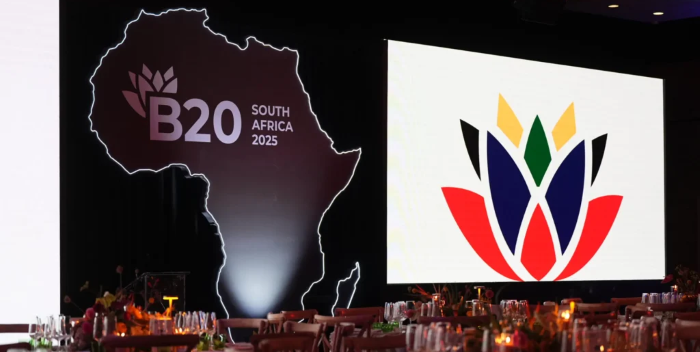
A pivotal high-level dialogue held during the B20 Summit in Johannesburg brought together influential African and global agricultural leaders to chart a pathway for the future of the continent’s food systems.
Hosted by Bayer and attended by representatives from the African Union (AU), the Alliance for a Green Revolution in Africa (AGRA), and First National Bank (FNB), the discussion sought to build alignment on the urgent, coordinated steps needed to strengthen food security and agricultural resilience across Africa.
Convened alongside the G20’s primary business engagement platform, the dialogue emerged as a timely response to escalating global challenges—ranging from climate extremes and geopolitical tensions to disrupted supply chains. While these pressures affect food systems worldwide, Africa faces additional hurdles, including persistent underinvestment in agricultural infrastructure and policy, despite its abundant arable land, youthful population and rich indigenous knowledge.
Rather than relying on external prescriptions, the conversation elevated African expertise and leadership. Speakers called for collaborative, cross-sectoral approaches rooted in Africa’s distinct social, economic and ecological contexts.
Debra Mallowah, Head of Crop Science for Bayer Africa, urged a shift from discussion to tangible delivery. “This decade must be defined by partnerships, not fragmentation,” she emphasized. “Africa has the land, the youth and the resilience to feed itself and contribute to global food supply. What we lack is time. With 2030 approaching, decisive action is essential.” Her words captured a shared sense of urgency: agricultural transformation is no longer speculative—it is imperative.
Dr. Ildephonse Musafiri of AUDA-NEPAD highlighted that progress requires collective responsibility. “Transformation won’t come from isolated efforts,” he noted. “When public and private sectors align, we unlock the systems-change that farmers and communities urgently need.”
The dialogue underscored agriculture’s critical role in Africa’s development. Employing roughly 60% of the continent’s workforce and contributing around 25% of its GDP, agriculture remains a cornerstone of economic stability, food sovereignty and rural livelihoods. Yet AGRA President Alice Ruhweza pointed to chronic underfunding. “Although agri-food systems generate a quarter of Africa’s GDP, they receive only 2% of government investment,” she explained—an imbalance that demands urgent correction.
Participants identified several priority areas for action, beginning with increased support for smallholder farmers, who supply up to 80% of Africa’s food but often lack credit, insurance, modern tools and reliable markets. Expanding blended finance and risk-sharing mechanisms, they argued, could unlock significant new capital while safeguarding farmers from climate and market volatility.
Digital innovation also emerged as a critical accelerator. Tools such as precision farming, weather intelligence, mobile finance and digital logistics are already helping some farmers adapt to growing uncertainty. Scaling these solutions in inclusive, context-appropriate ways will be essential.
Strengthening intra-African food trade was another key focus. Effective implementation of the African Continental Free Trade Area (AfCFTA) could lower dependency on food imports—currently costing the continent over USD 50 billion annually—and bolster regional supply chains.
Read Also;
https://trendsnafrica.com/south-africa-to-chair-g-20-can-it-make-a-difference/
Closing the session, Mildred Nadah Pita, Vice Chair for Sustainable Agricultural Food Systems at Bayer, reiterated the company’s commitment to Africa’s transformation. “The time is now,” she affirmed. “We will continue to support farmers with locally adapted seeds and climate-resilient solutions.” She also echoed President Cyril Ramaphosa’s message at the B20 Summit: Africa is ready for equitable partnerships and innovation-driven investment, marking a shift toward self-determined, enterprise-led growth. Overall, the dialogue signaled a united resolve: Africa’s agricultural transformation must be led by Africans, supported by genuine partnerships, and driven by implementation—not intention.