


(3 Minutes Read)
Africa’s vast forest landscapes, once vital absorbers of planet-warming carbon dioxide, have now become net emitters of carbon, according to new research that highlights an urgent need to protect the world’s most important natural climate regulators.
The study reveals a dramatic change that has unfolded since 2010: all three of the Earth’s major tropical rainforest regions—the Amazon in South America, the forests of south-east Asia, and those across Africa—have transitioned from serving as essential buffers against climate change to contributing to the accumulation of greenhouse gases in the atmosphere.
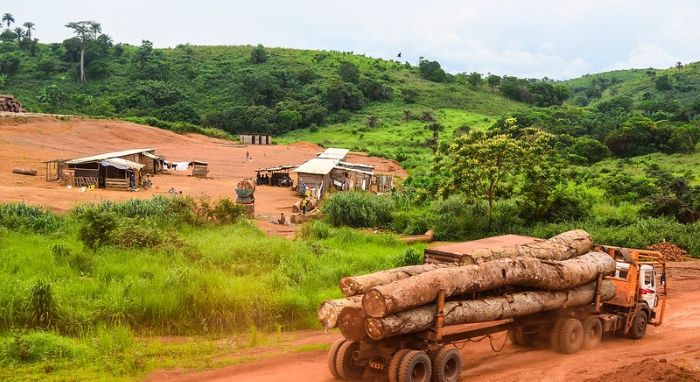
Human-driven pressures are at the heart of this shift. Expanding agriculture is clearing increasing amounts of land for food production. Infrastructure development, mining operations, and the accelerating impacts of global heating—largely caused by burning fossil fuels—are eroding ecosystem health and resilience.
Between 2010 and 2017, scientists found that African forests were losing around 106 billion kilograms of biomass every year, comparable to the combined weight of 106 million cars. The steepest declines were observed in the tropical moist broadleaf forests of the Democratic Republic of Congo, Madagascar, and several regions of west Africa.
The research, published in Scientific Reports, was led by experts at the National Centre for Earth Observation from the Universities of Leicester, Sheffield, and Edinburgh. Using more than a decade’s worth of satellite imagery combined with machine-learning analysis, the team assessed how the carbon content of trees and woody vegetation across the continent has changed over time. Their findings revealed that while African forests were still gaining carbon between 2007 and 2010, the onset of widespread forest degradation soon reversed this trend, causing the continent to release more carbon than it absorbs.
The authors warn that unless deforestation is halted swiftly, the world risks losing one of its most effective natural defences against climate change. They point to Brazil’s new initiative—the Tropical Forest Forever Facility (TFFF)—designed to channel over USD 100bn (£76bn) toward forest conservation by paying countries to preserve their ecosystems. Despite its potential, only a small number of nations have collectively contributed USD 6.5bn so far.
Read Also;
Professor Heiko Balzter, senior author and director of the Institute for Environmental Futures at the University of Leicester, stressed the need to accelerate investment in the initiative. According to Balzter, world leaders pledged at the COP26 summit in Glasgow to end global deforestation by 2030, yet current progress falls far short. He emphasized that the TFFF offers a practical mechanism for governments and private investors to counter destructive forces such as mining and agricultural expansion—but only if more countries commit funding.
He concluded that stronger protections and more decisive global action are essential if tropical forests—and the climate stability they provide—are to be preserved.