

(3 Minutes Read)
Africa imported hydrocarbon products worth USD 120 billion in 2024, according to Nigeria’s Minister of State for Petroleum Resources, Heineken Lokpobiri. The minister revealed this during the OTL Africa Downstream Energy Week in Lagos, highlighting both the continent’s vast energy potential and its ongoing infrastructure challenges.
Lokpobiri emphasized that the massive import figure underscores Africa’s strong demand for petroleum products but also exposes its limited refining capacity and weak distribution networks. “Because we have limited refining capacity and a constrained distribution network, most of the money still goes back to countries outside the continent,” he said. “Our target is to retain more of that value within Africa—starting with Nigeria as the refining and distribution hub.”
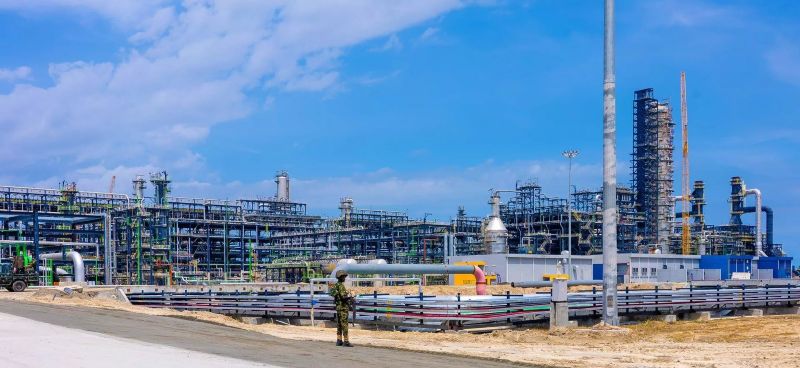
He noted that Nigeria is well-positioned to lead this transformation, as the Dangote Oil Refinery begins to significantly reduce the nation’s dependence on imported fuel. With a capacity of 650,000 barrels per day, the Dangote Refinery has quickly become a key player in West Africa’s energy landscape. According to Gary Clark of S&P Global Commodity Insights, the facility is already supplying diesel and aviation fuel across West and Central Africa, reducing reliance on European imports. “Before the Dangote refinery came online, West Africa depended heavily on imports from Europe,” Clark said. “Now, the refinery is exporting enough jet fuel and diesel to meet regional demand—and beyond.”
Dangote Group CEO, Aliko Dangote, has urged the Nigerian government to ban fuel imports, asserting that his refinery can fully meet the country’s energy needs. This has already led to a dramatic drop in Nigeria’s gasoline imports, from 500,000 barrels per day in early 2023 to just 88,000 barrels per day by Q1 2025. Dangote has also raised concerns about substandard fuel imports, describing Africa as a “dumping ground” for poor-quality petroleum products due to its import dependence.
Read Also;
However, the refinery’s operations have transformed Nigeria into a net exporter of refined products. Between June and July 2025, the company exported about one million tons of Premium Motor Spirit (PMS), according to Dangote. This shift has allowed Nigeria to overtake South Africa as the continent’s largest refined product exporter.
Research firm CITAC projects Nigeria’s fuel imports in 2025 will fall to 6.4 million tonnes, less than half of South Africa’s 15.5 million tonnes. Meanwhile, sub-Saharan Africa’s overall crude production jumped 77.8% year-on-year in 2024, largely driven by the Dangote Refinery’s operational surge.